
Introduction
Finding out that your cirrhosis is progressing can feel overwhelming. Many patients and their families start searching for answers late at night, wondering what comes next and whether a liver transplant is really the only option left.
If you or someone you love is going through this, you are not alone, and this guide will help you understand what worsening cirrhosis means and when it is time to consider a liver transplant.
Understanding Cirrhosis and Why It Worsens
Cirrhosis is the result of long term liver damage caused by conditions like hepatitis, fatty liver disease, or long term alcohol use. Over time, healthy liver tissue turns into scar tissue, making it harder for the liver to filter toxins, produce essential proteins, and support digestion.
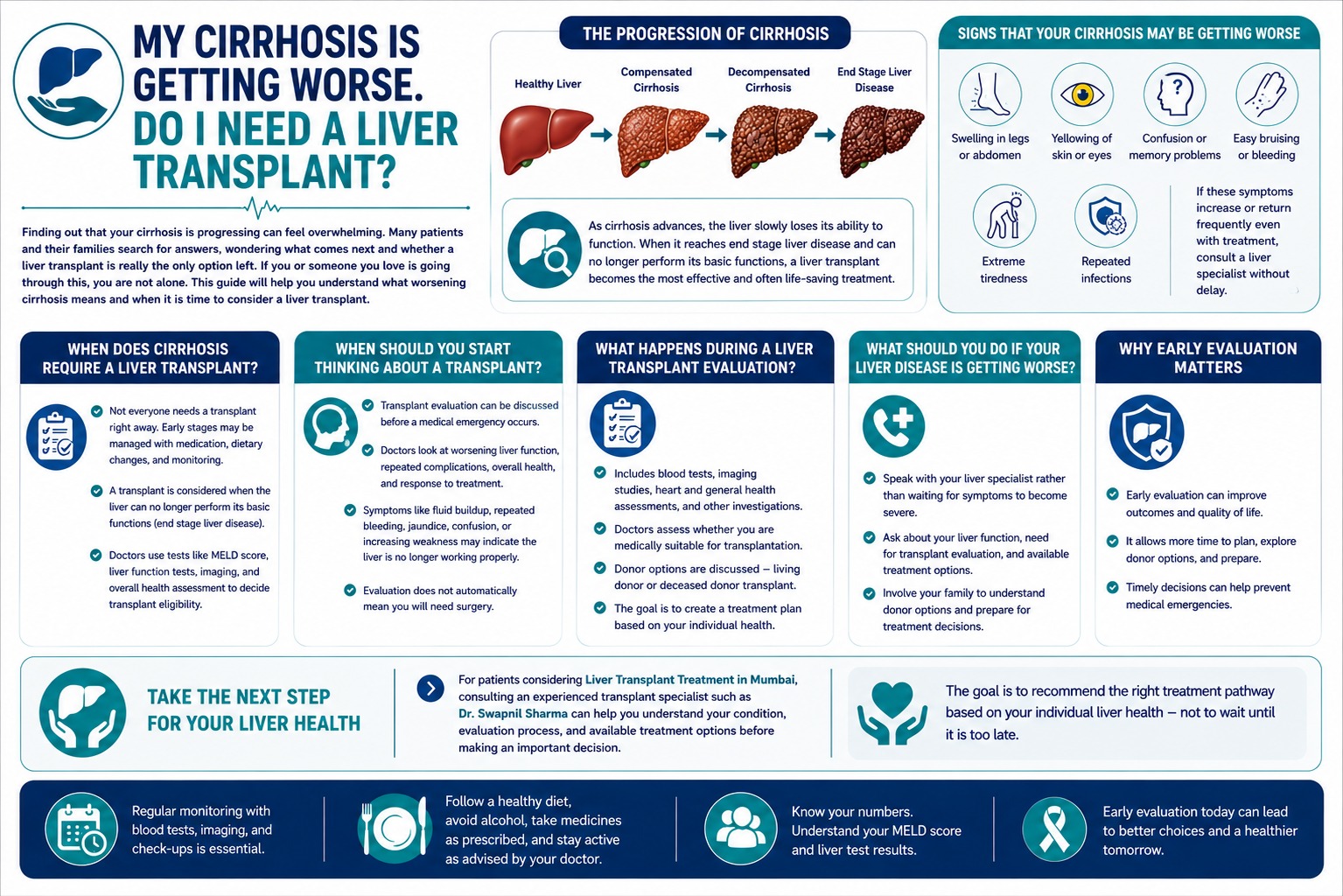
As cirrhosis advances, the liver slowly loses its ability to function properly, which is why doctors describe it in stages, from compensated to decompensated cirrhosis.
It is at this advanced stage that many patients and families in the city start looking into liver transplant treatment in Mumbai as a serious next step.
Signs That Your Cirrhosis May Be Getting Worse
Every patient is different, but there are common warning signs that suggest the liver is struggling to cope. These include swelling in the legs or abdomen, yellowing of the skin or eyes, confusion or memory problems, easy bruising, extreme tiredness, and repeated infections.
If you notice these symptoms increasing or returning frequently even with treatment, it is a strong signal to consult a liver specialist without delay.
When Does Cirrhosis Require a Liver Transplant?
Not everyone with cirrhosis needs a transplant right away. In the early stages, doctors often manage the condition with medication, dietary changes, and regular monitoring.
However, when the liver reaches a point where it can no longer perform its basic functions, known as end stage liver disease, a liver transplant becomes the most effective and often life saving treatment.
Doctors usually evaluate transplant eligibility using tests like the MELD score, along with liver function tests, imaging, and overall health assessment.
When Should You Start Thinking About a Liver Transplant?
Many patients with cirrhosis wonder whether they should wait until their condition becomes severe before considering a transplant. In reality, transplant evaluation can be discussed before a medical emergency occurs.
Doctors look at factors such as worsening liver function, repeated complications, overall health, and how well the condition is responding to treatment.
Symptoms such as fluid buildup in the abdomen, repeated bleeding, jaundice, confusion, or increasing weakness may indicate that the liver is no longer working properly.
Your doctor may also use blood tests and scoring systems such as the MELD score to understand the severity of liver disease.
An evaluation does not automatically mean you will need surgery. It simply helps your medical team understand your condition and determine whether a liver transplant may be appropriate.
What Happens During a Liver Transplant Evaluation?
If your doctor recommends a transplant evaluation, you may undergo several tests to assess your liver function and overall health. These can include blood tests, imaging studies, heart and general health assessments, and other investigations depending on your condition.
Doctors also consider whether you are medically suitable for transplantation and discuss possible donor options. For some patients, a living donor may be considered, while others may be evaluated for a deceased donor transplant.
The purpose of this process is to create a treatment plan based on your individual health rather than deciding on transplantation from a single test result.
What Should You Do If Your Liver Disease Is Getting Worse?
If you have noticed increasing abdominal swelling, yellowing of the skin or eyes, confusion, repeated bleeding, severe weakness, or other changes in your health, speak with your liver specialist rather than waiting for symptoms to become severe.
Ask your doctor how your liver function is changing, whether your condition requires a transplant evaluation, and what treatment options are available at your current stage of disease.
Keeping your family involved can also make it easier to understand donor options and prepare for possible treatment decisions.
For patients considering liver transplant treatment in Mumbai, consulting an experienced transplant specialist such as Dr. Swapnil Sharma can help you understand your condition, evaluation process, and available treatment options before making an important decision.